
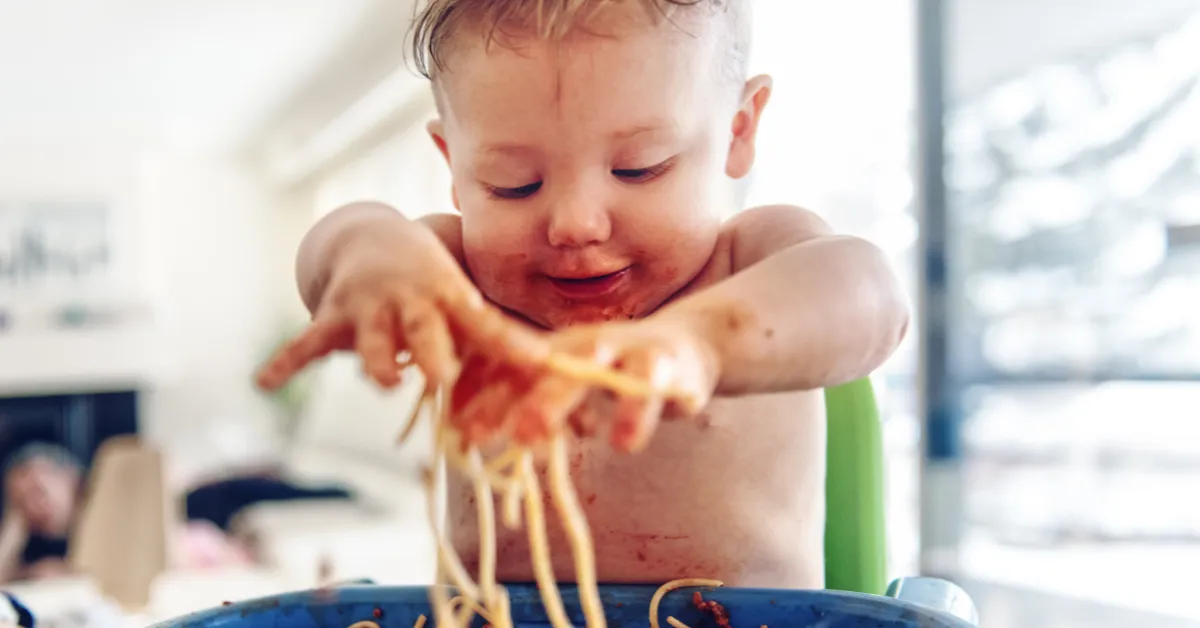
Toddlers throwing food is a normal part of development driven by curiosity, emerging motor skills, and limited verbal communication, often peaking between 12 and 18 months. Understanding the reasons behind this behavior — from sensory exploration to setting social boundaries — can help parents respond calmly and supportively while encouraging positive eating habits.
When your toddler flings another fistful of peas, it’s tempting to jump straight into discipline mode. But stepping back to understand the “why” behind food throwing can make all the difference. From curiosity to communication, your child may be showing you something deeper than defiance.
In this blog:
When a plate of food takes flight, it’s natural to feel frustrated. But take a breath—your toddler isn’t purposefully trying to cause chaos. At this stage, they’re acting like a curious little scientist, observing how the world works one toss at a time.
During this phase of development—what psychologist Jean Piaget called the “tertiary circular reactions” stage (usually between 12–18 months)—toddlers are driven by a need to understand cause and effect. That might look like asking:
Every food fling becomes a valuable experiment: they’re learning about gravity, exploring different textures, and even noting how you react.
Quick Tip: Stay neutral and limit your reaction—the bigger your response, the more entertaining the experiment becomes!
This kind of sensory play is essential for brain development and can lay the groundwork for a stronger, more positive connection with food in the long run.
Sometimes, food ends up on the floor because those tiny hands are still learning the ropes. As your toddler strengthens their pincer grasp—usually developing between 9 to 12 months—dropped food may be less about testing limits and more about practice in progress.
Throwing or dropping food can also be a stepping stone in building larger movements, like hand-eye coordination and arm control.
Parent Tip: Let go of perfection and embrace the learning curve—your child is gaining real skills at every messy meal.
So that seemingly chaotic dinner scene? It’s where real growth is happening—one blueberry at a time.
Before toddlers can fully express themselves with words, their actions tend to speak loudest. Throwing food can be their way of telling you:
It's helpful to remember that a toddler’s stomach is roughly the size of their clenched fist. That means they often feel full much earlier than parents expect.
Here are four simple strategies you can use to guide them:
When we understand what’s driving the behavior, we can be more patient, helping these messy moments feel less like missteps and more like part of your toddler’s learning journey.
Your response during a food-throwing moment matters—and it starts with how you react. Try to stay calm and use a steady, neutral tone when setting your boundary. A simple phrase like “Food stays on the table” can be effective.
Quick Tip: The more consistent your phrase, the more quickly your toddler learns what’s expected.
Strong emotional reactions might accidentally turn misbehavior into a game. By staying steady and consistent, you create a calmer, more effective mealtime environment.
Once you state the limit, give your toddler a chance to turn things around. If the behavior continues, respond with a logical, gentle consequence. For example, you might remove their plate briefly for 30 to 60 seconds.
Afterward, offer the plate again—and if the throwing starts up once more, it’s okay to let that meal be done. This approach isn’t about punishment.
Instead, it's a predictable outcome that connects their actions with natural consequences, which supports understanding and responsibility.
Parent Tip: Predictability helps toddlers feel more secure—even when a meal ends after a few bites.
Sometimes food throwing signals something else—like your child being full, over-tired, or needing attention. Rather than raising your voice or using time-outs, try to see what’s underneath the behavior.
After the meal, gently invite your toddler to help with cleanup. It’s another simple way to reinforce that actions have meaning. You might say, “We made a mess—let’s clean it up together.”
Hand them a washcloth or ask them to help pick up a few pieces from the floor. Keep it low-pressure and age-appropriate.
Not only does this foster independence, but it also encourages respect for the mealtime space in a way that feels kind and age-affirming.
A big pile of unfamiliar food can feel overwhelming to a toddler. Try offering small portions—about one tablespoon per year of age—and let them ask for seconds if they’re still hungry. This keeps things manageable and empowering.
Simple routines before meals can also create comfort. Washing hands together, singing a short song, or setting the table signals it’s time to focus and eat.
Quick Tip: Sit with your child and eat together to model calm eating habits—they learn best by watching you.
Sitting down without screens or toys reinforces focus and connection—essential for reducing distractions and throwing.
Helping your child feel involved in meals—even in small ways—can reduce food-throwing and boost cooperation. Toddlers love being part of the process.
Invite them to rinse veggies, stir something (with supervision), or carry their plate to the table. This sense of pride and ownership encourages cooperation.
Proper seating also plays a role. A high chair or booster with back and foot support helps toddlers feel grounded.
Parent Tip: Toddlers eat more calmly when their knees and hips are at a 90-degree angle—check their seating!
When their body is securely supported, they’re better able to focus on eating comfortably and securely.
There’s a difference between normal picky eating and something that needs extra support. Experts say many children labeled “picky” still eat about 30 foods on rotation. If your toddler is stuck on fewer than 20 foods, that could indicate a deeper issue.
If you’re noticing any of these, you’re not overreacting. It’s okay to ask for help—early support makes a big difference.
Some toddlers throw food because certain textures, smells, or even sounds feel overwhelming. If your child seems upset by the feel or sight of certain foods, it may suggest sensory sensitivities.
Oral-motor challenges—like issues with chewing and swallowing—can also lead to resistance and food throwing.
If you’re concerned, talk to your pediatrician or feeding therapist. They can help identify effective strategies to support your child’s learning and comfort.
Helpful tools won’t erase challenging behaviors overnight, but they can support a smoother mealtime experience—for both toddlers and their caregivers.
Start with secure seating. A high chair with a footrest offers physical stability to help your child focus and reduce food throwing.
Some families also enjoy using a child-sized weaning table and chair—often based on Montessori philosophy—to promote independence and positive eating habits.
Here are some real-life tools that can make messy mealtimes feel a little easier:
These tools aren’t magic, but they can take some of the stress out of feeding—while helping your child move toward more independent, joyful mealtimes.
Written by: Jessica Facussé, Co-founder of Little Lunches, chef trained at the International Culinary Center, Harvard Business School graduate, and one of Bloomberg’s Top 100 Innovators in Latin America.
Sources:
American Academy of Pediatrics, "Feeding & Nutrition Tips: Your 1-Year-Old"
ZERO TO THREE, "Why Do Toddlers Throw Things?"
Piaget, J., "The Origins of Intelligence in Children"
Lansbury, Janet, "The Real Reasons Toddlers Push Limits (and Why We Need to Push Back)"
University of Illinois, College of Agricultural, Consumer and Environmental Sciences, "Benefits of family mealtimes"
Nelsen, Jane, "Positive Discipline: The First Three Years"
Rowell, Katja, "Love Me, Feed Me: The Adoptive Parent's Guide to Ending the Worry About Weight, Picky Eating, Power Struggles and More"
1 year ago